“Another Mousetrap”
by Quinn Tyler Jackson


ars ipsa loquitur
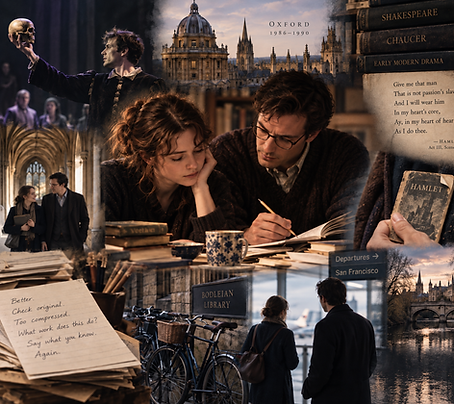
[Note: “Another Mousetrap” is a short story as imagined having been written by Valery Rockford after the events and timeline of the coda of The Fourth Winter. It is presented here as part of an imagined short story collection titled The Books Between Us: Beyond Echo and Shadow, possibly authored by her.]
“Another Mousetrap”
Valery Elizabeth Rockford
Simon Avery met Veronica in Michaelmas of 1986 because she argued with him about Hamlet, although strictly speaking they had already been introduced twice: once at a boisterous college dinner where neither remembered the other’s name, and once outside the Bodleian, when a mutual acquaintance stopped long enough to establish that Simon worked on Shakespeare and Veronica had come from Canada to begin a DPhil. What counted was the argument.
Simon had given a paper on the play within the play, less concerned with Claudius than with Hamlet’s confidence that performance could make visible what ordinary observation could not. Veronica waited until the questions were finished and followed him into the corridor. Hamlet, she said, had already decided what he meant to discover before the players ever walked onto the stage. Simon asked why, then, Hamlet bothered with the play. Because he wanted confirmation, she said.
“That isn’t what you said.”
“It’s what I meant.”
Simon shifted the folder under his arm. “Those are different things.”
She watched him for several seconds before asking whether he always did that. Simon said he was a Shakespearean scholar. Veronica laughed, and they went for coffee. There he learned that she was working on Donne, specifically on what happened when a conceit made unlike things claim identity without ever quite allowing them to become the same. Simon asked about the gold conceit in “A Valediction: Forbidding Mourning”: if separation only beat love to airy thinness, was Donne really overcoming difference, or merely finding a more elegant way to preserve it? Veronica said that was precisely the point. The gold could be made thinner and thinner without ceasing to be gold. The conceit promised continuity, but only by admitting what had happened to its shape. Simon disagreed with nearly everything that followed, which was how they discovered they quite fancied one another.
By the following summer she had a key to his rooms. A year later they had taken a place together, with enough books between them that the removal men complained and little enough money that they bought the cheapest dining table they could find. Simon’s Shakespeare occupied most of one wall; Veronica’s research moved steadily outward from the table until papers appeared on a chair, beneath the chair, and finally in orderly piles against the skirting board. Their engagement was similarly undramatic: a ring, dinner with friends, telephone calls to Canada and Simon’s parents, and afterward the dishes from breakfast still waiting in the sink.
Veronica had arrived at Oxford intending to become an academic, but publishing entered by degrees. She edited things for friends, began disappearing into London for meetings, and acquired magazines whose margins carried more pencil than some of the articles. Once Simon came home to find her sitting cross-legged on the floor among several versions of the same opening paragraph. He said she had spent an afternoon moving three commas. Veronica told him it was four because one had been removed. Simon counted again, conceded nothing, and went to make tea.
For almost four years their life altered mostly by accumulation: books, acquaintances, deadlines, dinners, places they meant to visit and did not, and professional possibilities spoken of as though time would arrange them properly. Simon’s work moved toward the reappointment to the retiring age everyone assumed would come; Veronica’s moved in a direction neither of them had named when she arrived. Then, in the spring of 1990, Simon came home carrying a stack of undergraduate essays and found an open bottle of wine on the dining table, two glasses beside it, and Veronica with an envelope in front of her.
“I’ve got it,” she said, and passed him the letter from the magazine in San Francisco.
Simon read both pages before returning to the beginning. He asked when it had come; Veronica said the day before. He asked when she had accepted; she picked up her wine and said that morning, by telegram. She began explaining before he asked anything else. They had wanted an immediate answer, and it was not an offer she could leave sitting for a week. They were giving her three months before she had to report. She could finish at Oxford in that time, though not the DPhil she had planned. The faculty thought there was enough work to reshape into an MPhil if she abandoned everything that did not serve it and treated the next three months as an emergency. They insisted on a viva voce.
He listened until she was finished. “And you said yes before speaking to me?”
“They needed an answer.”
“So did I, albeit to an entirely different question.”
“I’m giving you one now. I want you to come with me.”
He asked what she imagined he would do in San Francisco. She said there were universities in California. Simon said there were universities in Mongolia as well; Veronica told him not to be ridiculous. He had work in Oxford, he said, and she had work in San Francisco. She answered that yesterday she had had research in Oxford.
“And me.”
“That isn’t fair.”
“No. It isn’t. But it is true.”
She asked him again, more plainly, whether he would come. Simon said no. When she accused him of refusing before considering it, he reminded her that she had accepted before asking him. Veronica said the offer would have disappeared. Simon said that did not alter what she had done.
“I took a job.”
“You also decided where you were going to live, and by extension, where I would be living.”
“I decided what work I wanted.”
“You decided that too.”
She put down the glass. “Do you hear yourself?”
“Yes.”
“You make it sound as though I’ve done this to you.”
“You accepted a position six thousand miles away from the man you’re supposed to marry, who is a nose hair from reappointment to the retiring age at Oxford, not Berkeley.”
“And you’re refusing to move six thousand miles for the woman you’re supposed to marry.”
Simon folded the letter along the crease already made by the magazine and returned it to the envelope. “Then perhaps neither of us gets to say this was done by only one person.”
The argument lasted well into the evening but changed very little after that. Veronica said he was choosing Oxford over her. Simon said he was choosing to remain at Oxford, and she told him that was the same thing.
“It isn’t.”
“How can it possibly not be?”
“Because I am not asking you to stay here on my account.”
“That makes it worse.”
She asked whether tenure was worth more than the woman he intended to marry. Simon said he had not said that. Veronica told him he was saying it with every sentence and would say it again when he stayed behind.
“No,” he said. “You are telling me what staying means.”
“What else could it mean?”
“I have told you.”
“You’ve given me an answer.”
“Yes.”
“Not an explanation.”
“No.”
She stood and asked whether that was all he had to say. Simon looked at the essays he had carried home, then back at her. “No. But it is all I am saying tonight.”
“That’s very convenient.”
“It isn’t convenient at all.”
Veronica left the room. The wine remained open between their two glasses while Simon moved the undergraduate essays to the other end of the table and began marking them.
Three days later she put the first reorganised chapter of the MPhil beside his elbow. Simon looked at the manuscript and then at her. She said only that the argument changed halfway through and she did not know how to repair it. He opened to the first page and asked when she needed it. When she said tomorrow afternoon, he picked up a pencil.
For the next twelve weeks, the cheap but sturdy dining table became an examination room after dinner. Simon had already undergone his own viva and had helped younger scholars prepare for theirs. At first he was gentle enough that Veronica accused him of patronising her, so he abandoned gentleness.
The first week was mostly surgery. Her DPhil had followed the problem through the love poems, the Holy Sonnets and the Anniversaries, asking how Donne’s conceits could make unlike things claim identity without ever quite abolishing the difference between them. The MPhil could not simply be a shortened DPhil. The Anniversaries went first. Most of the devotional material followed. What remained was a narrower argument about identity and difference in the love poems, which meant rewriting the introduction, the conclusion and half the transitions as though that had always been the destination.
Simon made her identify what she could actually defend rather than what she had once hoped to prove. He crossed through half a page where she had spent three paragraphs anticipating an objection no examiner was likely to make, circled a citation she had taken from a secondary source, and sent her back to the original.
“I know what it says. And by the way, review, critique, or suggest; do not revise for me. Rules.”
“And we are clearly assuming that a strikethrough counts as critique—something akin to ‘This has shite holding it together.’”
“Anyway, the paragraph serves its purpose.”
“Then you lose nothing whatever by checking.”
She returned from the library the following afternoon and replaced the paragraph.
Another evening he stopped at what remained of the devotional chapter and asked why it was still there. Veronica said that without it she could no longer show the argument moving from erotic conceit into religious language. Simon asked whether the MPhil needed to show that specific movement at all.
“It matters.”
“That isn’t the question.”
“It was the question when I started.”
Simon waited. Veronica looked down at the pages and told him she hated him. He said she did not. She removed the chapter the following morning and made another entry in the log she had begun keeping: Simon’s critique, her original rationale for the contested material, and the decision she had made in response.
The rehearsals developed their own domestic rhythm. Sometimes they stopped after twenty minutes and ate; sometimes the plates remained beside them until the food was cold. Once Veronica threw a pencil at him after he found a contradiction she had spent two days believing she had repaired. It struck the wall several feet to his left. Simon retrieved it, placed it beside her hand, and told her that if she intended to throw things she should at least improve her aim.
“That was meant to miss.”
“Then congratulations.”
“You’re enjoying this.”
“No.”
“You are a terrible liar.”
“I am not lying.”
“That is exactly what a terrible liar would say.”
Simon pushed the chapter back across the table. “The contradiction is still there.”
She swore at him, but she repaired it.
By the third week he had begun asking questions without warning her which chapter they concerned. He asked her to justify the chronology of one source, then why she had privileged one archive over another, then whether a distinction she treated as fundamental in chapter one could survive the material she introduced in chapter four. Veronica reached for the thesis.
“Act like you won’t have that in the room.”
“I’ll have my own work in my head.”
“Then find it there, not in a crutch.”
She eventually identified the section and began defending it. Simon stopped her, and when she tried again he stopped her a second time. She was answering the question she wished he had asked, he said, rather than the one he had actually put to her.
“That’s ridiculous.”
“It’s also what you’re doing.”
“With the thesis?”
Simon turned a page. “Again.”
Veronica did not move. “You were going to say something else.”
“I changed my mind.”
“You always accuse me of not listening, then refuse to say the thing I’m supposed to hear.”
“I did not accuse you of anything.”
“You were about to.”
“No. You decided I was.”
She stared at him, then began the answer again. Simon stopped her at the same place.
A few nights later the work remained only work. They spent nearly an hour on the difference between two editions of a source and another forty minutes deciding whether a footnote belonged in the text. Veronica argued for keeping an appendix Simon thought nobody would read. He finally said that if she could defend its necessity in two sentences she could keep it. She did, and he drew a line through his own note.
“You’re letting me win?”
“You answered the question.”
“That isn’t the same thing.”
Simon looked at her over the page.
“Don’t.”
He laughed and made tea.
On another evening he stopped her six words into an answer because she was performing certainty she did not possess. Veronica said she was supposed to persuade the examiners. Simon told her she was supposed to answer them.
“That is what persuasion is.”
“No. Persuasion can survive a weak argument. A viva cannot.”
“You make everything sound like Shakespeare.”
“I haven’t mentioned Shakespeare.”
“You don’t have to.”
Simon leaned back. “Speak the speech, I pray you, as I pronounced it to you.”
“Don’t turn me into one of your players.”
“Then stop performing for me.”
She pushed her chair back. “You think I’m acting?”
“In the viva, yes.”
“You know perfectly well what I meant.”
“And you know what I meant.”
“No, Simon. I very often don’t.”
He closed the notebook. Veronica said that was the whole problem between them: he behaved as though precision of wording absolved him of responsibility for what another person heard. Simon answered that she behaved as though what she heard entitled her to improve what he had said.
“Improve?”
“Complete. Translate. Correct. Choose whichever word offends you least.”
She stood. “You really are insufferable.”
“Sometimes.”
The admission arrested the argument for a moment, but not for long. Veronica said she understood perfectly well that he did not want her to go, and Simon agreed. She said he nevertheless would not come, and he agreed with that too. When she demanded to know what she was supposed to make of two statements that could not possibly coexist, Simon said, “Both.”
“You can’t have both.”
“Neither can you.”
She reminded him that he was choosing Oxford. Simon corrected her: he was choosing to stay at Oxford. Veronica said that meant without her.
“If you go.”
“When I go.”
“Yes.”
She remained standing at the other end of the table. After a while she asked why he was still helping her.
“Because when you arrive at your San Francisco job,” he answered her in an even tone, “you owe it to yourself to do it with the Oxford degree you have earned and deserve.”
“That’s all?”
Simon gathered the loose pages into a single stack. “Give me that man that is not passion’s slave.”
She frowned. “What is that supposed to mean?”
“You know where it’s from.”
“I know where it’s from. I don’t know what you mean by it.”
“I know.”
“And?”
“No.”
She said his name. Simon said no again, carried the pages into his study, and returned ten minutes later with two cups of tea. They resumed at chapter five.
By June, Veronica could answer him without reaching toward the thesis, so Simon began asking questions for which she had no satisfactory answer. The first time she admitted that she did not know, he said, “Good.”
“I thought I was supposed to know.”
“You’re supposed to know what you know.”
“And if they ask what I don’t?”
“Say you don’t.”
“I could reason from—”
“Yes, you could improvise. You could even pull magic dust out your arse.”
“There’s a difference.”
“Not enough of one.”
He made her practise saying I don’t know without apology and I would need to check that without filling the silence afterward. Once she gave a careful answer and then weakened it by adding three unnecessary qualifications. Simon made her begin again and stop where the answer ended.
“You cannot improve everything by adding to it.”
Veronica looked at the pages between them. “I am beginning to suspect you think that applies outside a viva voce.”
Simon capped his pen. “Tonight it applies to yours.”
She let him have that.
On a Saturday afternoon they worked through lunch. Simon returned several pages covered in pencil, and Veronica accused him of hating the chapter. He said the evidence was thinner than the conclusion. She said narrowing the conclusion would make it weaker; Simon said it would make it more accurate.
“You always think accuracy is more important than force.”
“In an argument, yes.”
“In everything?”
“No.”
“You behave as though it is.”
Simon tapped the page. “This is an argument.”
“Convenient again.”
He gave her the pencil. “Narrow the claim.”
She read the passage, crossed out two sentences, and then asked whether he still believed San Francisco was a mistake. Simon said yes. She asked whether he thought she would be good at the work there. He said yes again.
That answer held her for a moment. Simon turned another page.
“Those aren’t inconsistent either.”
“You’re very irritating.”
“So I’ve been told.”
“By whom?”
“You, mostly.” He found his place. “Why does chapter three exist?”
Veronica gave him a look, then said, “Oh, fuck you and the folio you rode in on.”
Simon smiled. “Again.”
On the morning of the viva voce, Veronica stood in the kitchen doorway wearing the suit she had bought in London and asked whether it was too much to go under her gown. Simon said no without looking up from the kettle. She accused him of not looking, so he turned and looked carefully enough that she told him he was now being absurd.
“The jacket is fine.”
“That’s all?”
“What would you like me to say?”
“I don’t know.”
“Then fine seems safe. The gown will cover a multitude of sins, and that suit has none.”
She accepted the coffee and refused breakfast until Simon put two pieces of toast on a plate and handed it to her. At the door she stopped and asked whether he wished she would fail.
Simon set down the kettle. “No.”
“Even though—”
“No.”
“You could at least let me finish.”
“You were going to ask whether I want you to fail because passing means you can leave.”
“Yes.”
“No.”
She held the plate in both hands. “Sometimes you understand perfectly well what I mean.”
“Sometimes you say what you mean.”
The reply landed badly. Veronica put the untouched toast on the counter and reached for her coat. Simon watched her fasten it.
“That was unkind.”
“Yes.”
She looked at him.
“I’m sorry.”
Veronica nodded once. Simon picked up his coat and walked with her.
The viva lasted more than two hours. Simon waited outside. When Veronica came through the doors she stood several yards away and held up two fingers.
“Minor corrections.”
Simon nodded. “I told you you were ready.”
She crossed the pavement and put both arms around him. A bicycle bell sounded behind them, and they stepped aside together. Over her left shoulder Simon asked about chapter five. Veronica laughed against his coat and called him a bastard, but admitted that they had challenged it and that she had narrowed the claim.
“Good.”
She drew back. “I passed.”
“Yes.”
“I passed.”
“Yes.”
She kissed him, and he kissed her back. That night they opened the bottle of champagne which had been waiting in the refrigerator since Christmas, and neither mentioned that the same success they were celebrating had removed the last academic reason for her to remain in Oxford.
The remaining weeks were mostly boxes. Books were easiest: hers, his, hers with his notes in the margins, his bought with her money, duplicate Shakespeare, duplicate Chaucer, three copies of Hamlet. The battered edition Simon had used as a student stayed on his shelf. Veronica packed novels into tea chests and wrote SAN FRANCISCO across the tops in black marker.
Furniture was harder. Simon told her to take the desk; she said no one shipped a cheap desk across the Atlantic. He reminded her that she had chosen it. Veronica said they had chosen it together, then stopped and told him not to make a point of everything.
“I wasn’t.”
“You were about to.”
Simon looked at her. “Perhaps.”
They sold the desk.
Friends gave dinners. People spoke about opportunity, California, sunlight and new beginnings. Simon attended each one and corrected anyone who assumed he would be joining her later. Walking home from one of them, Veronica asked why he could not simply let people believe it and save everyone the awkwardness.
“Because I’m not coming,” he explained.
“They know that now.”
“They asked.”
“You could have said you hadn’t decided.”
“I have decided.”
“You don’t make anything easy.”
“No.”
“Do you enjoy that?”
“No.”
“You could occasionally lie for social purposes.”
“So could you.”
Veronica stopped walking. Simon took two more steps before stopping as well.
“What is that supposed to mean?”
“Nothing useful.”
“That has never stopped you before.”
Simon came back toward her. “I mean you have spent three months telling people that San Francisco is an opportunity, which it is, without telling them that accepting it ended our engagement.”
“Our engagement is ending because you won’t come.”
“And there we are again.”
She walked past him. Simon followed, and they went home without resolving which version either of them would tell at the next dinner.
Two days before the flight Simon went into Blackwell’s and bought a small edition of Hamlet, the sort that would fit into a coat pocket. At home he opened it to Act Three, found the page he wanted, folded down the upper corner, and closed the book before putting it in his coat.
They left Oxford before dawn. At Heathrow Veronica checked two suitcases and kept one bag with her. They sat together until the first call for her flight, then stood without immediately moving toward security.
“You can still come,” she said.
“No.”
“I had to ask.”
“I know you did, and I shan’t fault you that.”
Simon reached into his coat and handed her the book. Veronica turned it over once and looked at the title.
“I already own Hamlet.”
“Not that one.”
Veronica opened the book, found the folded corner and looked at him. “You’ve ruined my plan.” She explained that she had meant to make a bookmark on the flight, then took a small paper packet from her bag and opened it far enough to show a single square of gold leaf held against its tissue. She glanced from it to the turned-down page and held the packet out to him. Simon asked what he was supposed to do with it. “You’ll think of something.” He took it, and Veronica closed the book.
The final boarding announcement sounded. Veronica held the book against her coat before stepping forward to kiss him. When they separated she told him she had loved him. Simon said he knew, and Veronica immediately answered that knowing was not the same as saying it.
“No,” he said. “I love you.”
She shut her eyes for a moment. “That’s worse.”
“Probably.”
Another announcement named her flight. Veronica picked up her bag and said goodbye. Simon answered in kind. She walked several paces, stopped, and turned.
“I hope Oxford deserves you.”
Simon shook his head. “That’s still the wrong question.”
Veronica stood there another moment, the little Hamlet visible beneath her hand, then went through security. Simon remained until the moving crowd took her out of sight.
⁂
HAMLET
Horatio, thou art e’en as just a man
As e’er my conversation coped withal.
HORATIO
O, my dear lord—
HAMLET
Nay, do not think I flatter,
For what advancement may I hope from thee
That no revenue hast but thy good spirits
To feed and clothe thee? Why should the poor be flattered?
No, let the candied tongue lick absurd pomp
And crook the pregnant hinges of the knee
Where thrift may follow fawning. Dost thou hear?
Since my dear soul was mistress of her choice
And could of men distinguish, her election
Hath sealed thee for herself. For thou hast been
As one, in suffering all, that suffers nothing,
A man that Fortune’s buffets and rewards
Hast ta’en with equal thanks; and blessed are those
Whose blood and judgment are so well commingled
That they are not a pipe for Fortune’s finger
To sound what stop she please. Give me that man
That is not passion’s slave, and I will wear him
In my heart’s core, ay, in my heart of heart,
As I do thee.—Something too much of this.—
There is a play tonight before the King.
One scene of it comes near the circumstance
Which I have told thee of my father’s death.
I prithee, when thou seest that act afoot,
Even with the very comment of thy soul
Observe mine uncle. If his occulted guilt
Do not itself unkennel in one speech,
It is a damnèd ghost that we have seen,
And my imaginations are as foul
As Vulcan’s stithy. Give him heedful note,
For I mine eyes will rivet to his face,
And, after, we will both our judgments join
In censure of his seeming.
Books by this author:
Quinn Tyler Jackson has been a bookseller’s assistant, a freelance editor, a literary agent, an independent publisher, and a mathematician. Jackson is a Fellow of the Royal Society of Arts and a member of the Writers’ Union of Canada. His award-winning work spans nearly four decades and includes novels, short story collections, poetry, and short fiction published in literary magazines and online journals.
He lives on Gabriola Island in British Columbia with his beloved, where they make their home a cat sanctuary. He continues to write fiction and poetry, paint, compose and perform music, and conduct scientific research.